
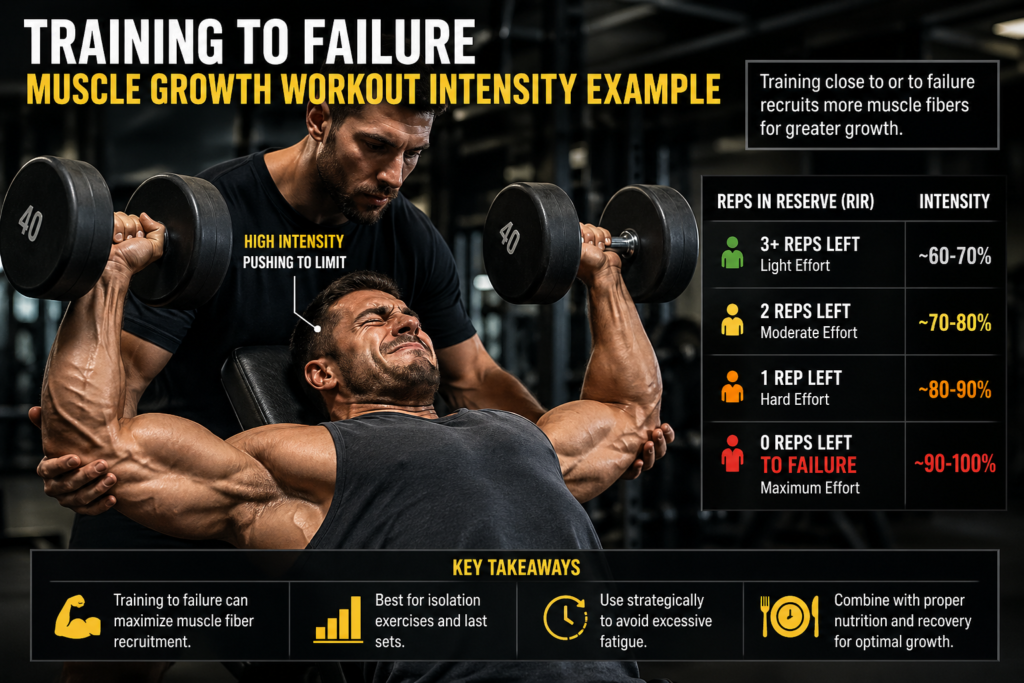
Training to Failure Muscle Growth: What You Need to Know
Training to failure muscle growth is one of the most debated topics in fitness. Many lifters believe that pushing every set until you physically cannot perform another rep is the ultimate way to build muscle. But is that really true?
In simple terms, training to failure means performing repetitions until your muscles can no longer complete another rep with proper form. While this sounds intense and effective, the reality is more nuanced.
Understanding training to failure muscle growth can help you train smarter, avoid burnout, and maximize your gains over time.
What Is Training to Failure?
Training to failure refers to reaching momentary muscular failure, where your muscles are too fatigued to continue a set.
There are two main types:
- Technical failure: You can’t perform another rep with good form
- Absolute failure: You can’t move the weight at all
Most experts recommend stopping at technical failure to reduce injury risk.
The Science Behind Training to Failure Muscle Growth
From a scientific perspective, muscle growth (hypertrophy) is driven by three key factors:
- Mechanical tension
- Muscle damage
- Metabolic stress
Training close to failure increases motor unit recruitment, meaning more muscle fibers are activated.
Research published by organizations like American College of Sports Medicine shows that training close to failure can stimulate muscle growth effectively—but it’s not always necessary to go all the way.
Studies suggest:
- Training 1–3 reps before failure can produce similar muscle growth
- Volume (total sets and reps) matters more than failure alone
Benefits of Training to Failure Muscle Growth
1. Maximum Muscle Fiber Activation
Training to failure ensures that even the hardest-to-recruit muscle fibers are engaged.
2. Time Efficiency
You can achieve high intensity in fewer sets, making workouts shorter.
3. Mental Toughness
Pushing to failure builds discipline and resilience.
Drawbacks You Should Know
1. Increased Fatigue
Constantly training to failure can lead to excessive fatigue, reducing performance in later sets.
2. Higher Injury Risk
Form breakdown near failure increases the chance of injury.
3. Recovery Issues
Overusing failure training can slow recovery and lead to overtraining.
For more Information do visit Musclegurus.org
Is Training to Failure Necessary for Muscle Growth?
The short answer: No, but it can help when used correctly.
Most research shows that:
- You don’t need to train to failure on every set
- Training close to failure is often enough
- Progressive overload is still the most important factor
Even natural lifters can achieve excellent training to failure muscle growth results without going all-out every time.
Best Way to Use Training to Failure
To maximize training to failure muscle growth, use it strategically:
1. Use It on Isolation Exercises
Safer movements like:
- Bicep curls
- Leg extensions
- Lateral raises
2. Avoid Failure on Heavy Compound Lifts
Exercises like squats and deadlifts carry higher risk when taken to failure.
3. Limit Frequency
Use failure training:
- On the last set of an exercise
- 1–2 exercises per workout
4. Focus on Progressive Overload
Gradually increase:
- Weight
- Reps
- Volume
Example Workout Strategy
- Bench Press: Stop 2 reps before failure
- Incline Dumbbell Press: Last set to failure
- Cable Fly: Train to failure
This approach balances intensity and recovery.
Expert Insight
Fitness experts like Brad Schoenfeld emphasize that training close to failure is sufficient for hypertrophy, especially when volume is controlled.
Final Verdict: Training to Failure Muscle Growth
Training to failure muscle growth is effective—but not essential.
Key Takeaways:
- Training close to failure works just as well
- Overusing failure can harm recovery
- Use it strategically, not constantly
If your goal is long-term muscle growth, consistency and smart programming matter more than pushing every set to the absolute limit.
Do Follow- Training to Failure Muscle Growth
Frequently Asked Questions (FAQs)
1. Is training to failure the best method for muscle growth?
Training to failure muscle growth is often considered an effective strategy, but it is not necessarily the best or only method for building muscle. Research shows that training close to failure—leaving 1–3 reps in reserve—can provide similar hypertrophy benefits without excessive fatigue. While going to failure ensures maximum muscle fiber recruitment, it can also reduce overall training volume and recovery capacity. Therefore, for optimal training to failure muscle growth, it’s better to use failure selectively rather than in every set of every exercise.
2. How often should I train to failure for muscle growth?
When it comes to training to failure muscle growth, frequency plays a crucial role. Most experts recommend using failure training sparingly—typically on the last set of an exercise or for isolation movements. Doing it too often can lead to overtraining, increased fatigue, and even injury. For sustainable training to failure muscle growth, limiting it to 1–2 exercises per workout and not more than a few times per week is a smart approach. This allows you to balance intensity with proper recovery.
3. Does training to failure build more muscle than stopping early?
Training to failure muscle growth does not always outperform stopping slightly short of failure. Studies indicate that stopping a couple of reps before failure can stimulate nearly the same level of muscle growth while allowing better performance across multiple sets. The key factor is effort, not necessarily reaching absolute failure. So while training to failure muscle growth can be effective, it is not significantly superior when compared to high-effort training that avoids complete exhaustion.
4. Is training to failure safe for beginners?
For beginners, training to failure muscle growth is generally not recommended as a primary strategy. New lifters are still learning proper form and technique, and pushing to failure increases the risk of poor execution and injury. Instead, beginners should focus on mastering movements, building consistency, and gradually increasing intensity. Once a solid foundation is established, training to failure muscle growth techniques can be introduced carefully and strategically.
5. Can training to failure cause overtraining?
Yes, excessive training to failure muscle growth can contribute to overtraining if not managed properly. Constantly pushing muscles to their absolute limit places a high demand on the nervous system and recovery processes. Symptoms like persistent fatigue, decreased performance, and lack of motivation may appear. To avoid this, training to failure muscle growth should be balanced with adequate rest, proper nutrition, and structured programming.
6. Should I train to failure on every set for maximum muscle growth?
No, training to failure muscle growth does not require going to failure on every set. In fact, doing so can reduce total workout performance and limit the amount of volume you can handle. Most effective programs recommend reaching failure only on the final set or during specific phases of training. This approach ensures you get the benefits of training to failure muscle growth without compromising overall progress.
7. Is training to failure better for isolation or compound exercises?
Training to failure muscle growth is generally safer and more effective when applied to isolation exercises like curls or leg extensions. These movements carry a lower risk of injury and allow you to push muscles to their limit safely. On the other hand, taking heavy compound lifts like squats or deadlifts to failure can increase injury risk and fatigue. For optimal training to failure muscle growth, reserve failure for safer, controlled movements.
8. Does training to failure improve strength as well as muscle growth?
Training to failure muscle growth can contribute to strength gains, but it is not the most efficient method for building maximal strength. Strength development relies heavily on lifting heavy loads with good form and sufficient recovery. Constantly training to failure may actually hinder strength progress due to fatigue. A balanced approach that combines heavy lifting with occasional failure training is ideal for both strength and training to failure muscle growth.
9. How does recovery impact training to failure muscle growth?
Recovery is a critical factor in training to failure muscle growth. When you push your muscles to failure, you create significant fatigue and muscle damage that require time to repair. Without proper recovery—adequate sleep, nutrition, and rest days—your body cannot adapt and grow effectively. Managing recovery properly ensures that training to failure muscle growth leads to progress rather than setbacks.
10. Can advanced lifters benefit more from training to failure?
Yes, advanced lifters often benefit more from training to failure muscle growth because they have already developed strong technique and recovery capacity. For experienced individuals, failure training can help break plateaus and provide a new stimulus for growth. However, even advanced lifters should use it strategically, as excessive reliance on training to failure muscle growth can still lead to fatigue and diminishing returns.