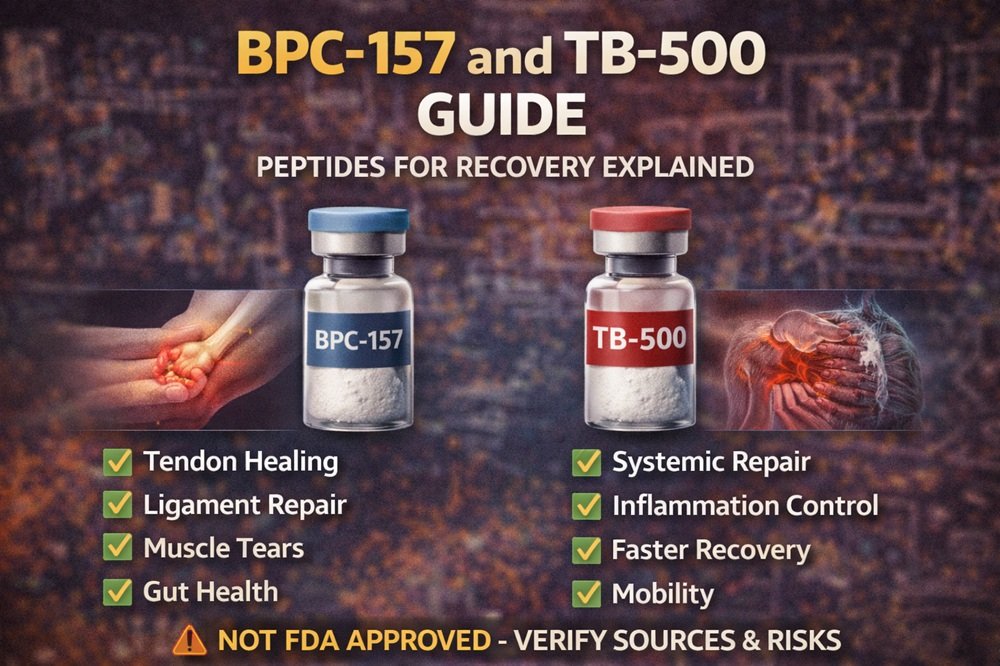
The demand for peptide-based recovery solutions is exploding—and the BPC-157 and TB-500 guide is now essential reading for serious lifters. From tendon pain to muscle tears, these peptides are being discussed as potential tools to accelerate healing and recovery. But misinformation is everywhere. Below, we break down what BPC-157 and TB-500 actually are, how they differ, potential benefits, real risks, and why bodybuilders must approach peptides with caution in 2025 and beyond.
Quick Answer (Featured Snippet Bait)
Quick Answer:
This BPC-157 and TB-500 guide explains that both peptides are used for recovery support—BPC-157 primarily for tendon, ligament, and gut healing, and TB-500 for systemic tissue repair and inflammation reduction. Neither peptide is FDA-approved, and misuse carries legal and health risks.
What Are Peptides? (The “What”)
Peptides are short chains of amino acids that act as signaling molecules in the body. Unlike steroids, peptides do not directly increase muscle mass, but may influence:
- Tissue repair
- Inflammation control
- Cellular signaling
The BPC-157 and TB-500 guide focuses on recovery—not hypertrophy.
What Is BPC-157?
BPC-157 (Body Protection Compound-157) is a synthetic peptide derived from a naturally occurring gastric protein.
Potential Benefits Discussed
- Tendon and ligament recovery
- Muscle tear healing
- Joint pain reduction
- Gut lining support
Why Bodybuilders Use It
- Chronic elbow, knee, or shoulder pain
- Training through high-volume or heavy loads
⚠️ Important: Most evidence is animal-based, not large human trials.
What Is TB-500?
TB-500 is a synthetic version of a peptide fragment related to Thymosin Beta-4.
Potential Benefits Discussed
- Systemic tissue repair
- Reduced inflammation
- Improved mobility
- Faster soft-tissue recovery
Why It’s Popular
TB-500 circulates systemically, meaning it’s often used for full-body recovery rather than site-specific injuries.
BPC-157 vs TB-500: Key Differences (The Meat)
| Factor | BPC-157 | TB-500 |
|---|---|---|
| Primary Use | Tendons, ligaments, gut | Whole-body recovery |
| Action | Site-focused | Systemic |
| Inflammation | Moderate | Strong |
| Research Base | Mostly animal | Mostly animal |
| Muscle Growth | ❌ None | ❌ None |
This BPC-157 and TB-500 guide emphasizes that neither peptide replaces rest, rehab, or proper programming.
Potential Risks & Reality Check (YMYL Section)
⚠️ Health Concerns
- Lack of long-term human safety data
- Unknown effects on cancer pathways
- Dosing inconsistencies
- Injection-related infection risk
⚠️ Legal Status
- Not FDA-approved
- Sold as “research chemicals”
- Use may violate athletic organization rules
This makes peptides high-risk tools, not supplements.
Evidence & Trust Signals (Why MuscleGurus Is Cautious)
Across bodybuilding forums and injury-recovery logs:
- Some users report reduced pain
- Others see no benefit
- Placebo effect is common
- Poor sourcing leads to contamination
The BPC-157 and TB-500 guide stresses source verification and conservative expectations.
FAQ: BPC-157 and TB-500 Guide
Q: Are BPC-157 and TB-500 steroids?
A: No. They do not build muscle or suppress testosterone.
Q: Are these peptides legal?
A: They are not FDA-approved and are sold for research purposes only.
Q: Can peptides replace rehab or rest?
A: No. They should never replace proper injury management.
Q: Do peptides show up on drug tests?
A: Some athletic organizations ban them—testing policies vary.
Conclusion & CTA
This BPC-157 and TB-500 guide makes one thing clear: peptides are not magic recovery drugs. While some lifters experiment with them, the risks, legal gray areas, and lack of human research mean they should be approached with extreme caution.
👉 Want real recovery strategies that don’t rely on gray-market compounds?
Explore the MuscleGurus Injury Prevention & Recovery Hub and join informed discussions.
Medical Disclaimer
This article is for educational purposes only and does not constitute medical advice. Peptides are not FDA-approved for human use. Consult a qualified healthcare professional before using any peptide.